


Welcome to the third issue of EarthLore’s Quarterly HighLights, where every three months we share inspiring stories, reflections, photos and video clips of our work.
For over 10 years, EarthLore has been accompanying rural farming communities in South Africa and Zimbabwe on journeys to revive local seed diversity, deepen indigenous knowledge systems, and strengthen traditional farming practices and customary laws that align with the principles of Earth Jurisprudence. Earth Jurisprudence recognises that human communities are part of a wider Earth community, governed by the laws and limits of Nature. Central to our work is the protection of ancestral lands and ecologically sensitive Sacred Natural Sites and support for their restoration, vitality, and continued role in maintaining ecological and cultural integrity.
In this issue, we share news about EarthLore’s journey with communities in Bikita, Zimbabwe, and Mpumalanga and Limpopo provinces in South Africa, whose work contributes to the agroecological movement in the region through remembering, sharing, and reviving traditional seed-saving methods and indigenous farming practices that have declined over time. During this quarter, the work has also identified forgotten and neglected Sacred Natural Sites; restored and re-storied the landscape; shared indigenous knowledge; and strengthened neglected rituals and practices. A central theme this quarter highlights what is possible when women, men, youth and broader communities stand together in service to the greater good.
Learning Together from the Past and the Present
In Mazwimba, Venda farmers from the neighbouring villages of Mphagane, Maname, Tshiavha, and Tshiendeulu gathered in July for a dialogue that brought together youth and elders to share critical knowledge. The day included a monitoring visit to the Mazwimba Community Learning Centre to assess a bee hive installed during a prior workshop. This practical exercise resulted in peer to peer learning and the decision to expand the apiary, while strengthening the learning centre as a demonstration site for sustainable beekeeping and agroecological learning.
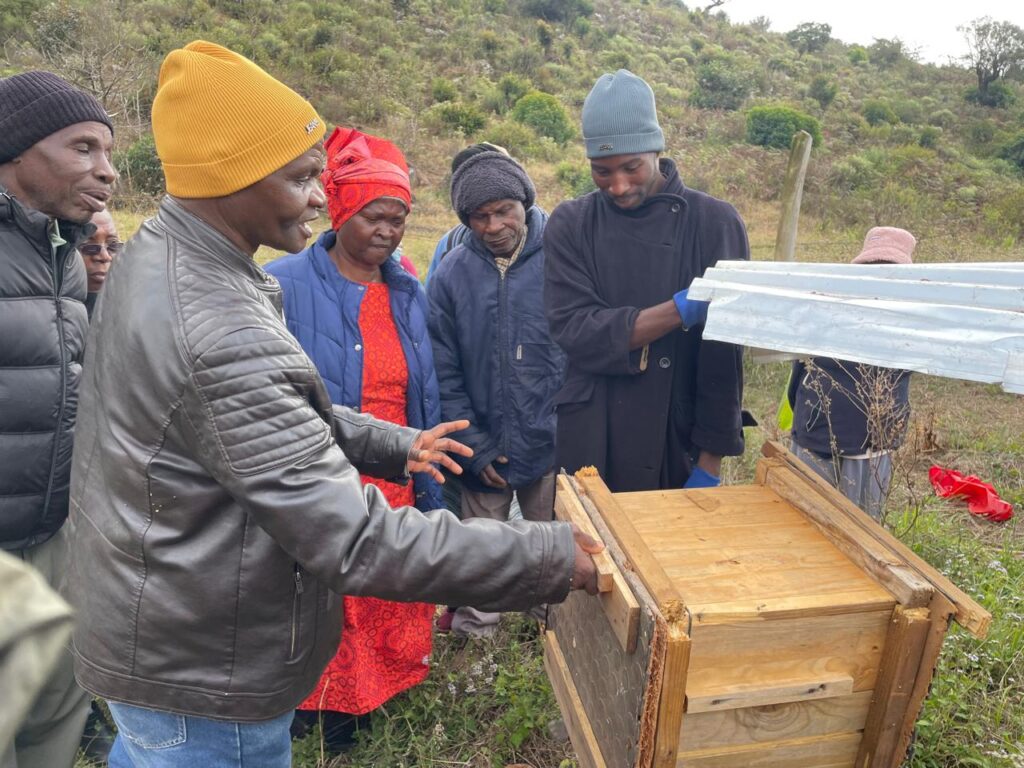
Farmers inspect the structure and construction of a wooden bee hive during the learning exchange in Mazwimba.
To promote intergenerational learning, youth were paired with knowledgeable elders who provided mentorship. Elders shared their knowledge of indigenous crops, flowering plants, and trees that provide forage for bees. They also identified crop varieties that are well-adapted to local conditions. They discussed and demonstrated traditional seed saving techniques and the preparation of natural pest repellents. Many of these traditional seed-saving methods have declined over time, yet remain relevant for conserving biodiversity, strengthening seed sovereignty, reducing dependence on external agricultural inputs, and improving resilience to environmental and climatic challenges.
A common traditional practice is u fhahea, where seeds, like maize and sugarcane, are hung in the kitchen and smoke from the fire acts as a natural, non-toxic pest repellent. For long-term preservation, communities relied on the tshisiku, a subterranean storage pit that keeps food crops and seeds cool, dry, and protected from insects and rodents. Storing seeds in a sealed calabash or a clay pot with ash from maize cobs, aloe, and the Muonze plant, protects them from insects, moisture, rodents and air. Reviving these indigenous methods not only reduces reliance on poisonous synthetic chemicals, but also preserves vital indigenous knowledge as a heritage for future generations.
Elder Vho Regina Manenzhe urged those present: “Let this be the last meeting where we see seeds stored in modern bottles. Let us increase the use of traditional seed-saving containers and reclaim our indigenous ways of preserving seeds.”
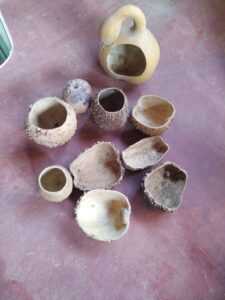
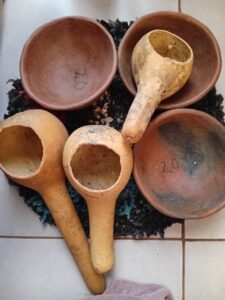
The challenge by elder Vho Regina Manenzhe to use traditional containers is being heeded by Vho Clara Nemakhavhani from Phungoni who made these unusual calabash containers and the clay bowls.
Intjomelo Ritual fosters Collaboration and Celebration in Steenbok
Preparations started early in July for the Intjomelo ritual, which was held on 1 August in Steenbok, Mpumalanga, South Africa. It was encouraging to see the enthusiasm of some of the young men who lent their youthful strength and energy to the more laborious tasks, like pounding the maize for the special traditional beer that is served during the ritual. The beer is brewed solely from traditional maize harvested from the field of the Induna (local headman) who is holding the ritual. No other ingredients are added. No sorghum. No millet. And definitely not hybrid or bought maize. Many years have passed since the beer was brewed this way, as the elders used to do it, so the recipe and method are still being perfected.
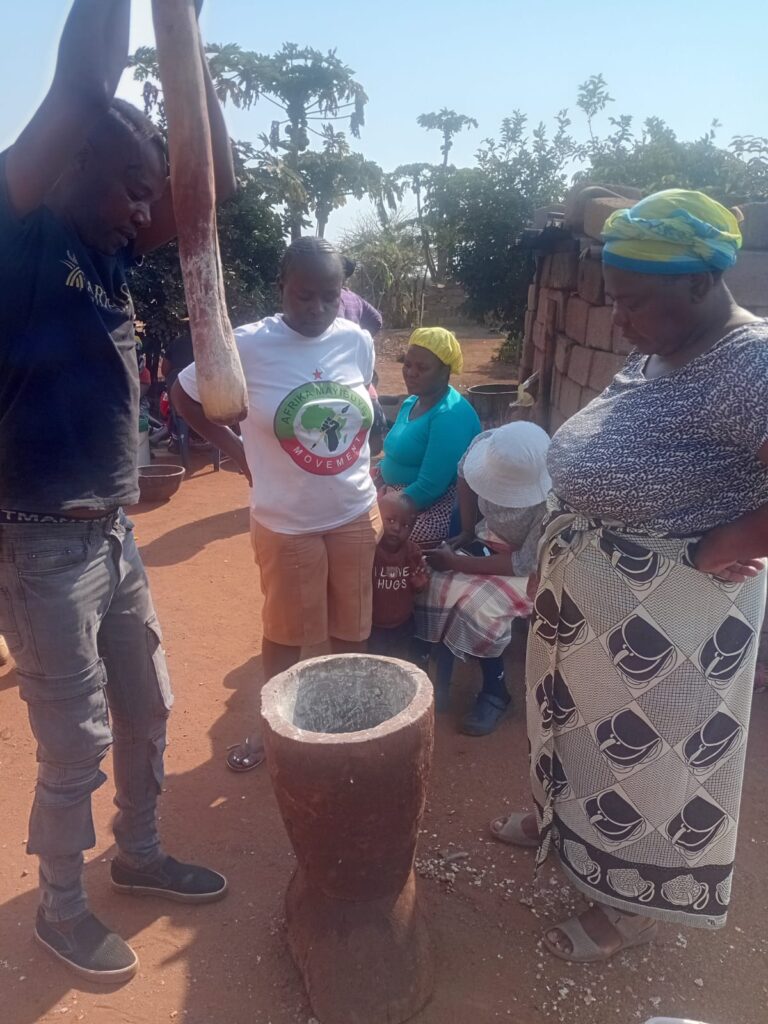
A combination of strength and accuracy is necessary to use the heavy wooden pestle, called Musi, to pound maize kernels to flour in the wooden mortar or Likhovu.
The energetic young man has the power but not the stamina of the older Mama who keeps going.
It’s a veritable hive of activity in Steenbok with many people involved in preparations for the Intjomelo ritual.
This is the second year that the ritual is being performed in Steenbok since it fell into obscurity about 20 years ago. The community was committed to improving on the performance of the ritual in 2025, when, understandably, several glaring omissions and commissions were made.
The responsibility of hosting the Injomelo ritual rotates each year. This year, the ritual was held at Induna Silabela’s homestead to give thanks and celebrate the harvest from the Induna’s field. On the day, elders, women, youth and community members gathered at the homestead. The ritual started with a traditional prayer and protocol was followed by the elders presenting gifts of dried roasted maize, roasted peanuts, intjomelo beer and meat to Induna Silabela.
After Induna Silabela tasted and accepted the intjomelo beer and blessed the gifts, the ceremony began. Women performed joyful traditional dances and everyone participated, including elders and youth. During the proceedings, Induna Silabela addressed the community and, once again announced they were celebrating Intjomelol. He extended an invitation to everyone in the community to gather at his homestead and to rejoice with him. He also instructed that no one should sell traditional beer on that day as sufficient beer had been brewed for everyone.
The Injomelo ritual indicates it is time for the men to move the cattle from where they have been feeding in the fields to the forest. This opens the way to start preparing the fields for planting.
In the reflection after the Intjomelo ritual, the only concern raised by the elders was that plastic buckets and containers had been used for the beer. They advised the community to go back to using traditional clay pots and calabashes for rituals. This advice has been taken to heart and, already a local source of clay has been found and women have been identified who want to learn to make traditional clay pots.
Rituals play an important role in establishing right relationships not only with the ancestors but within the communities. From the moment planning and organising these gatherings starts, inter-generational learning, collaboration, cohesion and unity is strengthened. And so is joy and happiness!
Ten Years of Seed Fairs in Bikita
EarthLore’s arrival in Bikita in 2015 ignited the revival of indigenous seeds and traditional knowledge. The farmers quickly responded when they saw the value of these changes and, a couple of years later, in 2017, South African farmers were invited to the first Bikita Seed Fair to witness how the farmers were reviving and multiplying their lost seeds.
Ten years later, on 27 August 2026, a joyous crowd gathered under an initially cloudy sky that brightened to match the day’s vibrant energy. The event was hosted by Maitezano Garden, Nebarwe, the newest Bikita community to be accompanied by EarthLore. This annual event is always a highlight for the Bikita farmers, visitors and guests. People came from near and far to celebrate the momentous milestone of ten years of reviving and safeguarding indigenous seeds, traditional practices, community cohesion and resilience, and how this nurtures seed sovereignty, food security and cultural cohesion. The gathering included farmers from five other gardens in Bikita accompanied by EarthLore: Chamas, Kumboedza, Chirambaguyo, Dende, and Mabheka. There were also farmers from Elukwatini, Steenbok, and Venda in South Africa, joined by local traditional leaders, representatives of government ministries, ZIMSOFF, and the EarthLore team.
The 10th anniversary stood out for its spirit of unity, with Bikita farmers from each of the six community gardens choosing to pool the seeds and crops of their members and exhibit collectively, rather than as individual farmers. As Shamiso Chindevani from Chamas Garden, Gangare, declared: “In Bikita we have a diversity of home grown food to eat. There is enough to feed our families and surplus to share or sell. We can write a book about the many changes EarthLore has brought to Bikita.”
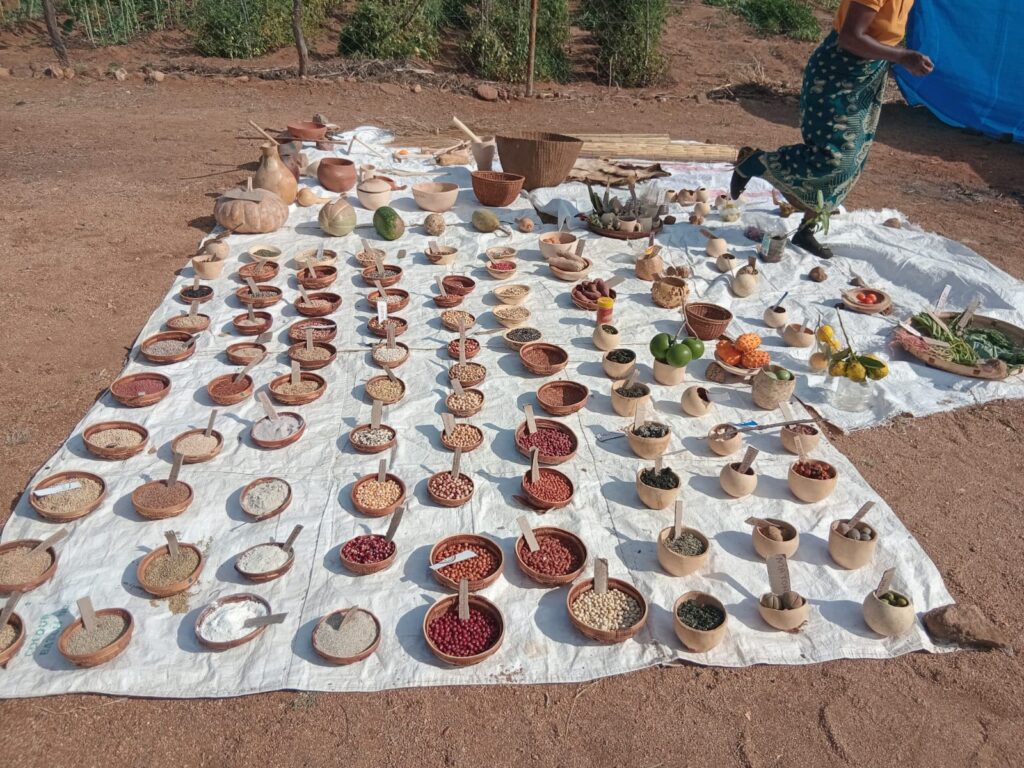
One of the six displays at the Bikita Seed Fair showcasing the seed diversity, crops and crafts produced by members of the community.
Many reflections were shared including the story of how a small packet of svoboda (Barnyard Millet), a seed previously thought to be extinct, has been multiplied and is now spread across the region, extending to KwaZulu-Natal in South Africa. There were several references to how the revival of sacred Finger Millet, which is used to brew ceremonial beer, is reviving traditional rituals.
Over the past decade, the farmers, communities, chiefs, and local leaders have taken ownership of this work of rooting the future in the past and in their traditions. The revival of important rituals and traditions lies securely in the hearts and hands of the Bikita communities themselves. This annual event marks one of the many achievements of the Bikita farmers who have demonstrated that, when they come together, they are one.
Reflections of a Bikita Seed Display Judge
Monica Chaminuka is an Agricultural Business Advisory Officer (ABAO) with the Department of Agriculture in Bikita, Zimbabwe. When Monica connected with EarthLore, she soon started observing changes in what some farmers in Bikita were planting and the positive results that followed. It did not take long for the types of crops to change. In a few years, the focus shifted from maize to traditional grains capable of surviving the minimal rainfall in the area. The government has since adopted this trend, actively supporting and promoting the planting of millets. Chemical fertilizers are still being supplied to local farmers, but not as much as before.
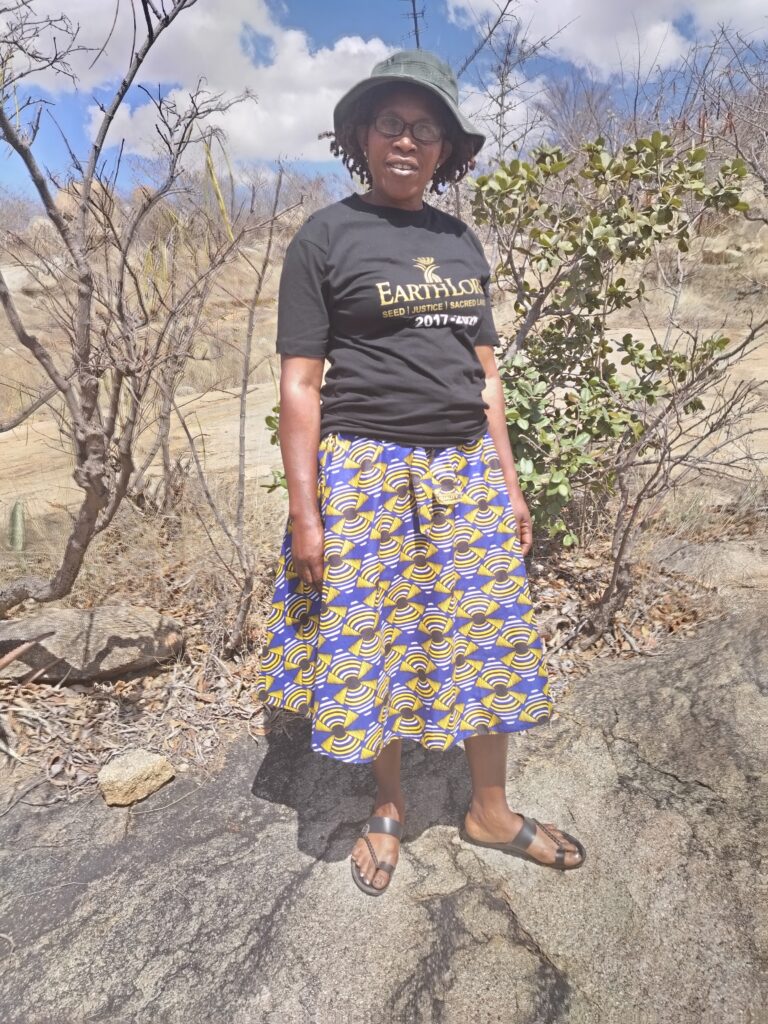
Monica Chaminuka, Agricultural Business Advisory Officer, with the Department of Agriculture in Bikita, Zimbabwe, who has been a judge of the seed exhibits at the Bikita Seed Fair since 2017.
In 2017, when Monica and a couple of colleagues were invited to judge the seed displays at the first Seed Fair, the seeds were few and the diversity was small. Within a couple of years, the annual Bikita Seed Fairs had grown and attracted many farmers who wanted to display their seeds individually. Over the years, the number of individual displays grew to well over 300. It took the judges several hours to visit and assess all the displays. They would meet at the displays soon after sunrise and work until after 9:00 am. They took the role of judging the seed displays at the Bikita Seed Fairs seriously and were committed to doing a good job in appreciation of the hard work of the farmers throughout the year.
For the judges, every farmer with a seed display was a winner, though, among the farmers, there was strong competition for the coveted first place. While this competition was good for a time, the decision this year to revert back to combined community displays made the judging much easier. The judges were able to assess and appreciate the full diversity of seeds across each of the six Bikita communities EarthLore works with. In 2026, they recorded an average of over 60 species and a total of 123 varieties. This is a noteworthy achievement in ten years. Several species, previously thought to be extinct in the area, have been revived—most famously amongst these is Svoboda, or Barnyard millet.
Monica concluded by saying: “One of the most inspiring things to see is how everyone works together. It is not only about caring for your garden and fields but healing and transforming landscapes. Such achievements are possible when there is a strong sense of community solidarity.. Collaboration is key to addressing climate change and the environmental crises we are facing. I look forward to seeing what emerges during the next ten years.”
Water Harvesting that Changes Lives and Heals Landscapes
The water harvesting learning exchange, held the day after the Bikita Seed Fair, provided a hands-on learning experience in gabion building for visiting farmers from Venda and Mpumalanga, South Africa, and representatives from the other five communities in Bikita who EarthLore accompanies.
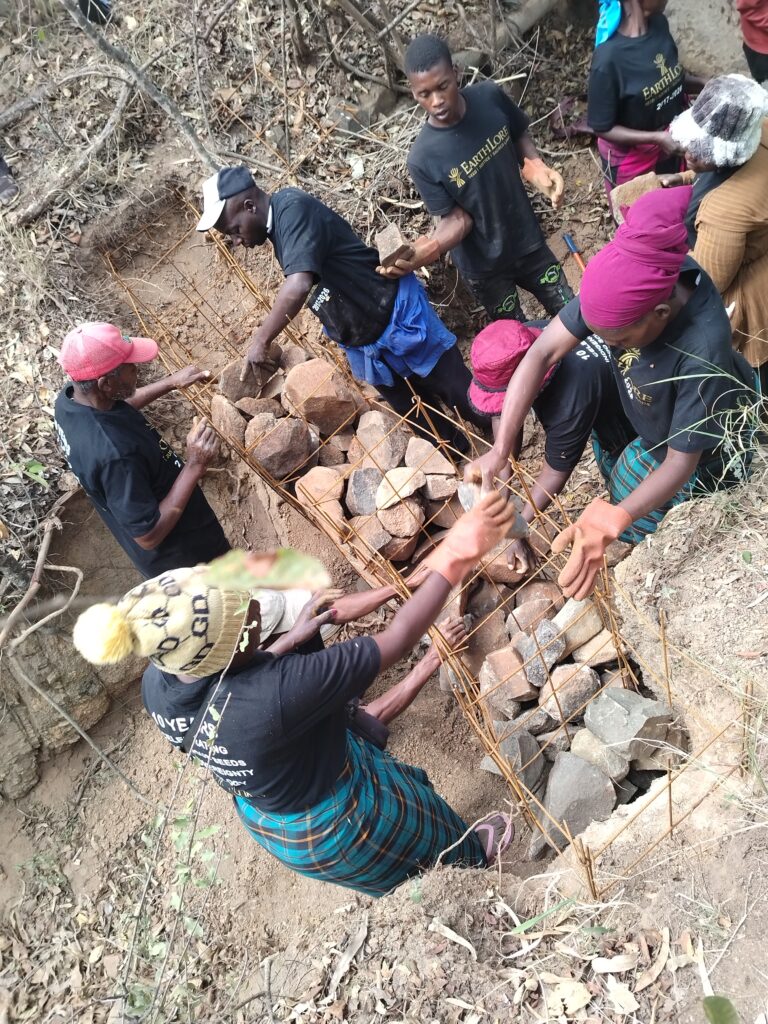
The Mamutse community working together to pack stones into a wire mesh cage spanning an eroded river to create a strong gabion to slow down turbulent water from the mountain.
In 2023, when the water harvesting program was launched in Mamutse, Mabheka garden led the way by implementing this literally groundbreaking initiative. Faced with severe water shortages, soil erosion, and a drying landscape, members of the Mabheka garden, under the guidance of one of our partners, PORETO, constructed swales, contours, gabions, and earth dams designed to slow, spread, and sink rainwater across the land. Water harvesting work spread swiftly from Mamutse to Mutsinzwa, Gangare and Masasire, with Chirorwe and Nebarwe following at a slower pace.
“This work might look easy at a glance but it is backbreaking and we faced many challenges along the way. Several features were destroyed during the severe storms at the start of 2026, and we had to repair and rebuild them again. So, when visiting farmers want to implement water harvesting, they must be prepared to work hard and face these challenges without giving up,” advises Mai Elizabeth Turugari, a central figure in the Mabheka garden.
Enthusiastic singing by members of the Mabheka garden reveals the unity and determination at the heart of the water harvesting work in Mamutse.
The power of this dedicated community-led action has recharged the local water table and keeps the nearby Chinyasikana River flowing well into the dry season. It provides an inspiring demonstration of the resilience, unity, and determination at the heart of this work to heal one’s ancestral land and reclaim and revive one’s heritage, rituals and culture.
Joyous Jaka Ritual
On 29 August, the quiet village of Chipote in Bikita, Zimbabwe, came alive as host farmer Mai Mbuya Chigweshe and the Dende Garden project prepared for the Jaka ceremony. The importance of this ritual, a practice that bridges generations and cultures, is illustrated by the fact that it drew family members and partner organisations from across Zimbabwe, as well as farmers from Venda and Mpumalanga, South Africa. The presence of a film crew from the United Kingdom was greeted with ululations and enthusiastic dancing. Amy and Chris were in Bikita on behalf of The Gaia Foundation to document work facilitated by EarthLore since 2015.
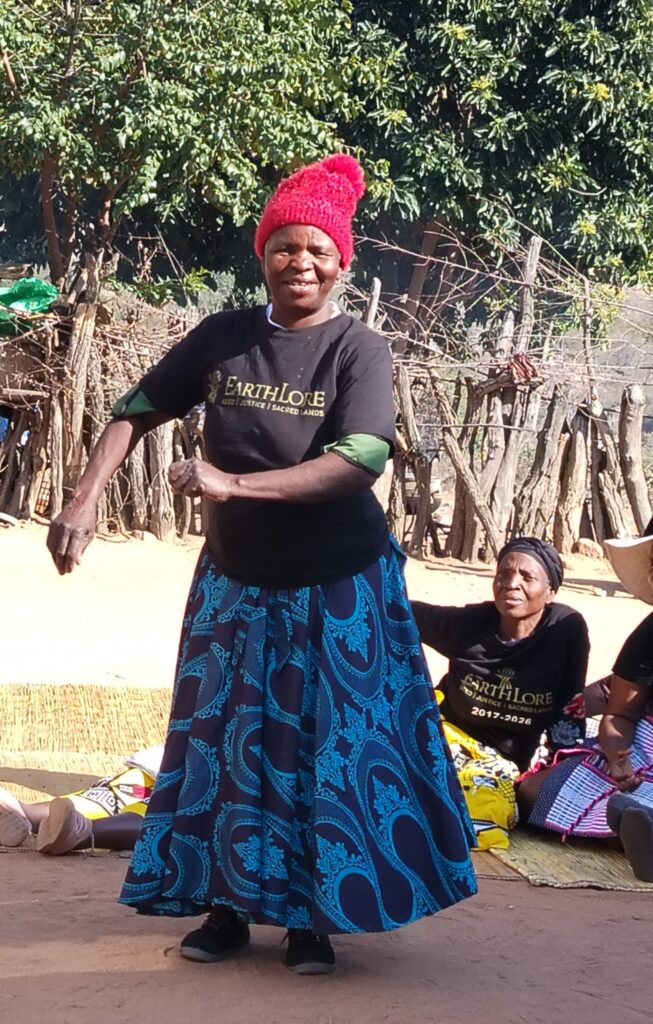
Exuberant host farmer, Mai Mbuya Chigweshe, welcoming everyone to their family homestead in Chipote village, Chirorwe, for the Jaka ceremony.
The South African farmers, dressed in their colourful traditional clothes, made an impressive arrival at the Chigweshe homestead when they emerged from their taxi singing traditional songs and dancing. They were clearly ready to start the celebration!
After the welcome, visitors were invited to visit Mai Mbuya Chigweshe’s fields to learn about millet cultivation and storage. Traditionally the harvested millet is stored in a Tsapi, a structure that still needs to be constructed at the Chigweshe homestead. From there, the group was led to a flat granite rock nearby, referred to as ruware, where the Jaka ritual would take place. Women swept the surface of the ruware to remove sand and stones before the harvested millet was spread out across it.
Bringing the millet to the ruware, a flat granite rock, where the Jaka ritual would take place and the Finger Millet would be threshed and winnowed.
The Jaka ritual, where the community would work together to process the small Finger Millet grains, was ready to begin. Men and women, including youth, rhythmically beat the millet with long flexible whip-like sticks, sourced from a particular tree that grows along the banks of rivers. The action of beating the millet was accompanied by vulgar adult songs, led by the older women. This is one time when it is not only permissible for the women to use crude language and sexually prevocative gestures, but it is actively encouraged as an important part of the ritual. Sometimes referred to as “ritual profanity” or “sacred obscenity”, the role of this vulgar behaviour is to challenge social taboos, invert restrictive hierarchies, and access the raw, chaotic spiritual power of renewal. To add to the spirit of abandon, traditional sorghum and millet beer was served to rouse and inspire flagging energy,
After the strenuous work of threshing the millet, the men retired to the shade of the homestead to sample more brew while the women prepared for the winnowing. With flat woven tswanda baskets in hand, they stood patiently on the ruware waiting for favourable afternoon breezes to aid the winnowing of the chaff from the grain. Soon the distinctive small red finger millet grains were swept into piles on the ruware before being safely gathered and carried back to the homestead in big traditional baskets, called matengu and plastic basins. There, some of the precious harvest was shared with the neighbours who had come to help and the remainder was stored in the granary.
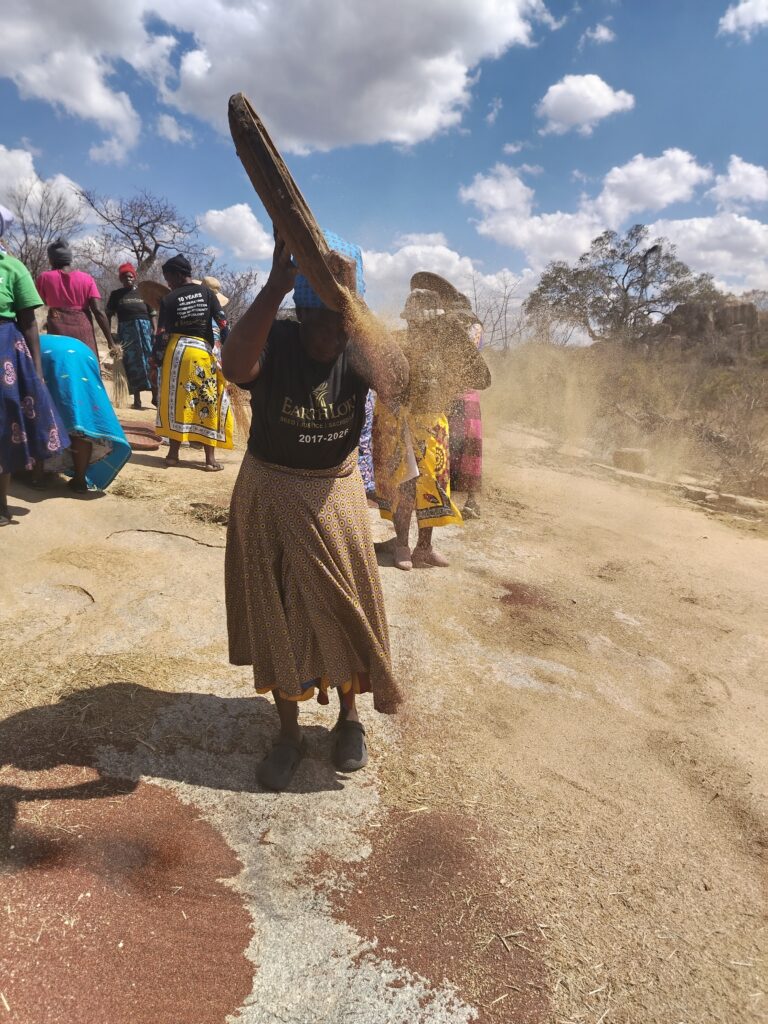
The afternoon wind blows away the chaff and the small red grains of Finger Millet accumulate on the surface of the ruware to be swept into piles to be gathered and safely carried to the homestead for storage in the granary.
The day culminated in a communal feast and a final beer-drinking ceremony. It was a bounteous day that served to preserve Bikita’s intangible cultural traditions and living heritage, while fostering vibrant community connections and cohesion.
Suko Seed Blessing Ritual Strengthens Seed Sovereignty and Builds Community
The final highlight this quarter is the Suko seed blessing ritual held in Mazwimba, Venda, at the end of September. Members of four villages neighbouring Mazwimba, came together for the ritual. It was to invoke and honour the ancestral spirits and request their guidance and blessing for the traditional and indigenous seeds that will be planted during the upcoming planting season. The ritual also called for favourable rains, and sought protection against destructive weather, like the hail that had recently devastated vegetable gardens of farmers in Elukwatini.
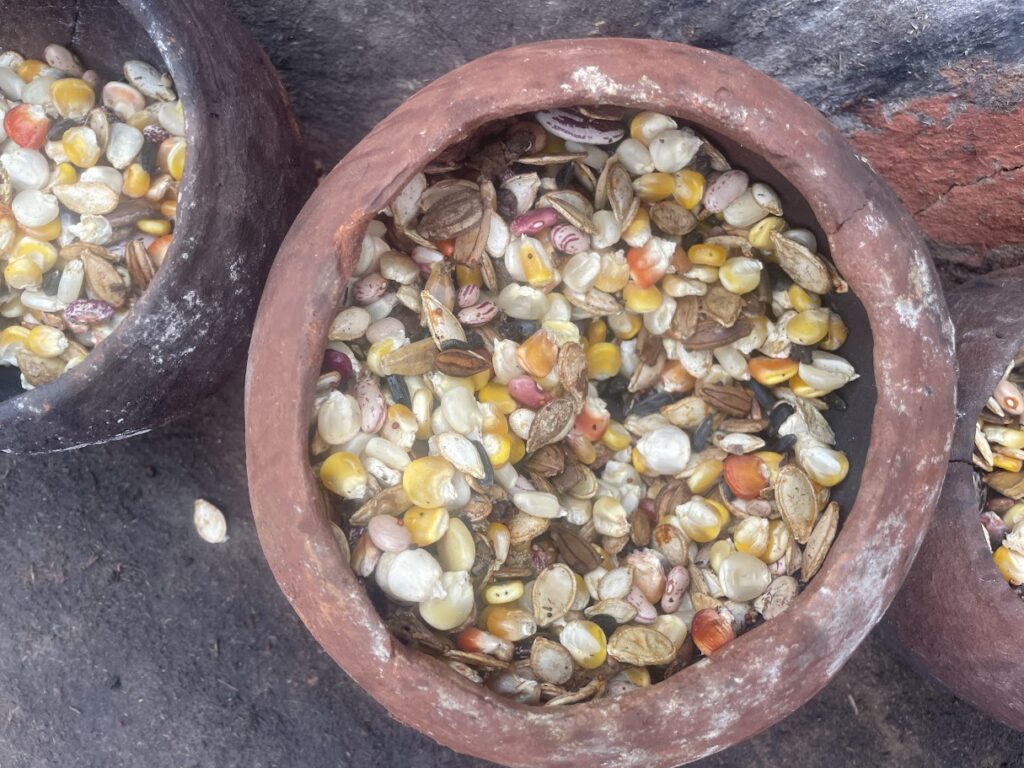
Seeds from farmers combined in bowls before the seed blessing ritual
Each successive Suko seed blessing ritual refines and strengthens this important cultural practice that was revived a mere 3 years ago, after being neglected for over 40 years. Each occasion creates a fresh opportunity for knowledge sharing between generations.
This year, the Suko ritual marked a milestone in intergenerational transfer, as spiritual leader Vho Merium Netshilunzhe formally taught the sacred steps of the ritual to elder Vho Rosina and to Seani Manyoka, a young woman committed to learning about the Venda culture. Women are historically recognised and honoured as custodians of seed and food systems. Children, who symbolise purity and hope, also played central roles in the gathering, anchoring the practical act of farming within shared spiritual and communal life.
During the ritual, farmers contribute their individually saved seeds to a collective offering to be blessed. These mixed seeds are then distributed back among everyone present who takes them home to plant them. This cycle of bringing, mixing, blessing, sharing, and planting ensures that seed sovereignty remains a lived practice—building climate resilience, honouring the natural world, and securing nourishing harvests for future generations. By preserving a diverse range of seeds, rural farmers ensure resilience against climate change and pests.
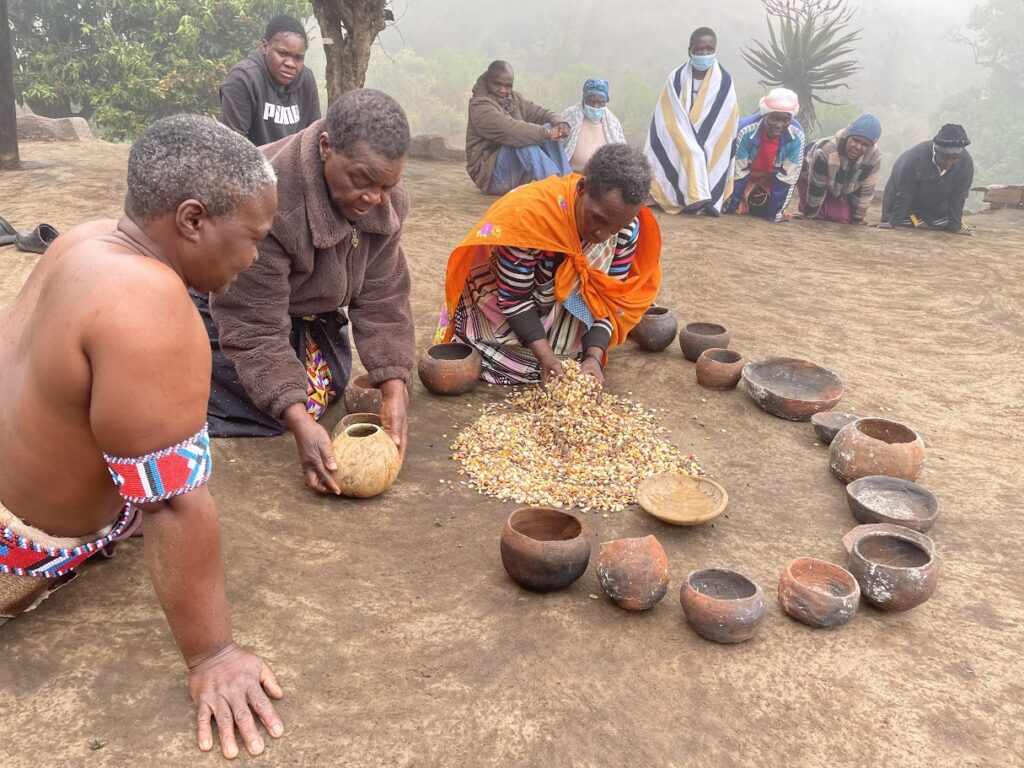
ho Merium Netshilunzhe watches over Vhakoma Vho Netshiavha and Vho Rosina and guides them as to how to perform Suko the seed blessing ritual. Seani Manyoka, as a young woman, is at the back listening respectfully.
EarthLore’s partners in South Africa, Zimbabwe and other southern African countries, and further north in Kenya perform similar practices. Knowing one is not alone, empowers local farmers, builds confidence and reduces dependence on commercial seed companies. And blessing seeds during Suko imbues this movement with deep spiritual purpose.
We hope you enjoyed this third edition of EarthLore’s Quarterly HighLights. Look out for the next one focusing on the last quarter of the year, October to December 2026.

