


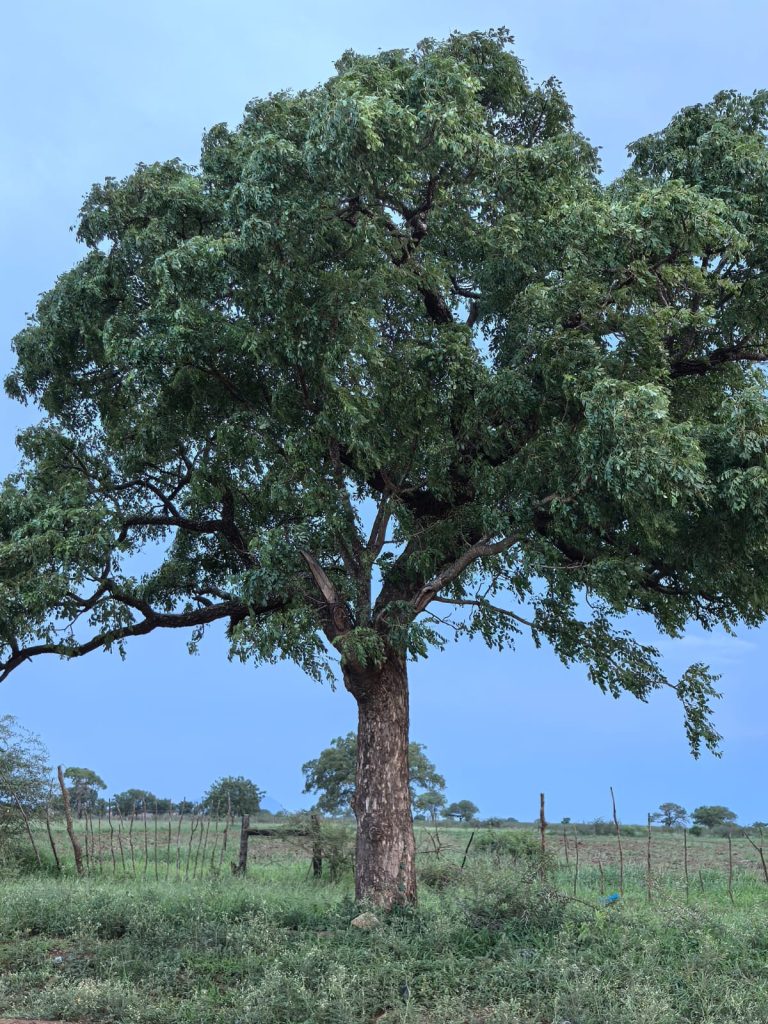
 March 2024 was a busy month for sangoma Xolosile ‘Xoli’ Themba, who is EarthLore’s main link with the work in Steenbok. At last, after 27 years, the community of Steenbok had agreed to revive the Ihhula (marula) ceremony, also known locally as Emaganu and Ubuganu.
The Marula tree has deep spiritual significance in many African cultures, and is often associated with fertility, healing, and community. It is considered a sacred tree that has the power to connect people with their ancestors and the spirit world. These trees used to be common in the Steenbok area, but many have been chopped down or burnt and are now quite scarce. As more and more people understand the important role of Marula trees in the landscape, interest is growing in propagating and replanting these special trees.
The big day arrived on 14 March 2024. The last time the Ihhula had been performed in Steenbok was in 1997. As a traditional health practitioner, Xoli is concerned that African people have forgotten about their ancestral life and adopted Western ways. She is particularly aware of the importance of reviving traditional practices and forgotten ceremonies and rituals that restore respectful relationships with Mother Nature. For Xoli to see the community performing the ritual of Ihhula was like a dream come true.
“Steenbok has not received rain for years and we are struggling without water. This was too painful to my heart because we used to be blessed with rain but were not receiving even one drop of rain…. Since EarthLore came and helped Steenbok go back to the life of our ancestors, the elders started to remember the life that they were living before. They understood why we are suffering like this now. It is because we have forgotten about our customs and traditions. They said we need to start with the Ihhula ceremony as it helps to clean and boost the body of the men. It starts in February, which is called indlovane in isiSwathi. The word indlovane means the small elephant. The time of marula is the time when elephants have babies and the time when men clean themselves. The Ihhula ceremony is a way of uniting the community. Since we started to speak about going back to our roots we have received rain. It is not much but at least we are having some, unlike before. I thank the Gods of our forefathers and the community for getting together on this path we have decided to take.”
In January, EarthLore adopted 2024 as the Year of Rituals in recognition of the growing interest in ceremonies and rituals amongst farming communities EarthLore accompanies in Mpumalanga and Venda, South Africa, as well as in Bikita, Zimbabwe. Many communities are reviving neglected and almost forgotten rituals associated with farming, rain, and sacred rivers, springs and lakes, as well as Sacred Natural Sites (SNS).
Steenbok’s Ihhula ceremony was one of the first rituals to be performed in 2024. The event was well attended. The Chief’s representative and members of the royal council were there together with traditional leaders and sacred site custodians. An official from the Department of Cooperative Governance and Traditional Affairs (CoGTA) also attended.
Induna Sambo opened the event with a song and laid down snuff, calling upon his clan names and ancestors to be present. A warm welcome was extended to Mpumalanga farmers from Enkaba, Julius Mkhonto, Avontuur, and Embuzini and representatives from Venda, as well as farmers from Mutsinzwa, Bikita, in Zimbabwe. All had come to show their support and to experience how Steenbok conducted the Ihhula ceremony because they would soon be performing similar ceremonies of their own. Stories of revived rituals and ceremonies were shared to inspire one another.
Method Gundidza, the Director of EarthLore Foundation drew an important connection between trees, land and the Ihhula/ Emaganu/ Ubuganu ceremonies. He described how in many African traditions chiefs are addressed as the soil, and so, when we are thanking our chiefs, we are also thanking the land that gave us the trees and those buried beneath the soil, whom we call our ancestors. As we celebrate and invoke the ancestors by observing our traditions, we honour that spirit and the land. We cannot enjoy a healthy life without healthy land. Method called upon traditional leaders to support communities trying to revive their traditional rituals.
It is important for rituals to be done with precision and attention to detail to honour the ancestors and achieve the desired outcomes. Given that 27 years had elapsed since the Ihhula ceremony had last been performed in Steenbok, it was to be expected that certain things were not done correctly. These were noted and will be rectified the next time the ritual is performed.
Induna Zulu from Mpumalanga commented that:
“…. While there has been a lot of forgetfulness, I am impressed with Steenbok’s efforts to revive Ihhula. It is important to remember that cultural revival requires collaboration and understanding between the elders and the youth. We should come together and work together to ensure that the richness of our traditions is preserved for future generations.”
The representative of the Chief, in his closing remarks, acknowledged the traditional leaders, the visitors, and the community of Steenbok for their contribution to reviving Ihhula.
“All the learning we have shared together needs to be put into practice. When we are reviving the traditional practices, we must remember that these are the laws of the land that govern us. As soon as we are born, the laws apply to us. As soon as we pass on, the laws apply to us. As we invoke our spirit, laws guide us. We prevent rain from falling when we destroy Marula and other indigenous trees and wetlands. Let us obey the laws of the land.”
| Marula trees are dioecious, which means male and female flowers grow on separate trees. The female trees bear female flowers and fruits while the male trees bear only male flowers. The delicious fruits are very high in Vitamin C and are eaten by people and a wide range of animals and birds. They are also brewed to make a refreshing drink that is very popular. Oil is produced from the nuts and the hard shells and used for cooking, preserving meat, treating leather, as a skin lotion and in cosmetics. Toasted nuts are considered a tasty delicacy. The green leaves are eaten to relieve heartburn. The bark contains antihistamines and is used for cleansing by steeping a handful of bark in boiling water and inhaling the steam. To treat dysentery, fever, malaria or diarrhoea, people drink a piece of bark crushed into a pulp and mixed with cold water. There are also claims that Marula bark helps treat diabetes.
Given all these attributes, it should come as no surprise that the siSwati culture has a special ritual dedicated to the Marula. |

