


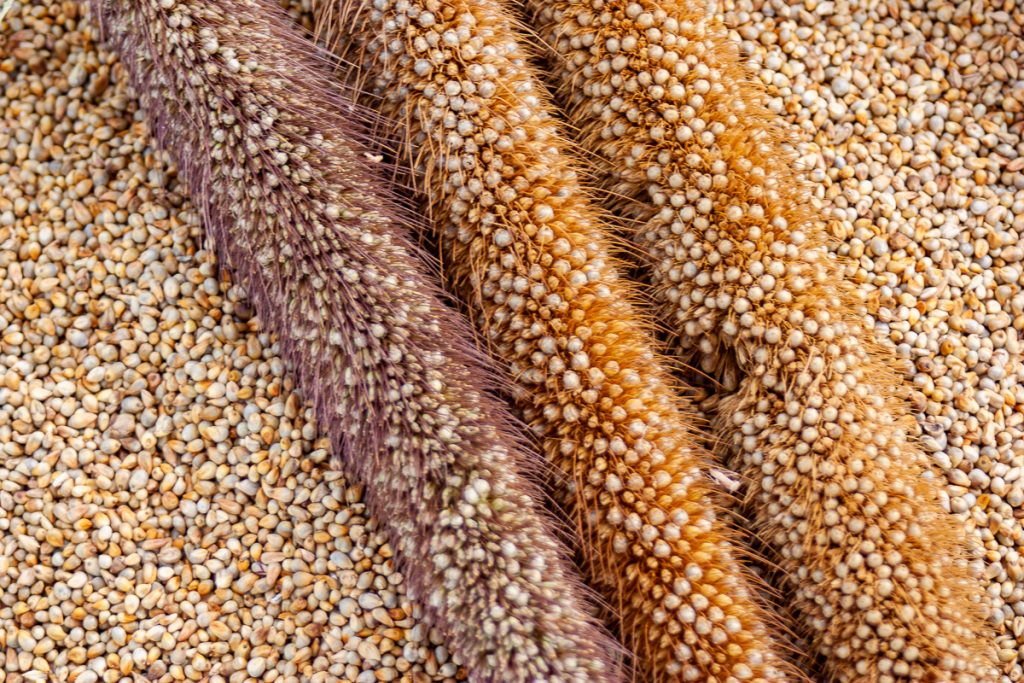
Pearl Millet (photo by Rob Symons)
At EarthLore Foundation, developing resilient seed systems is a process that is centred around community dialogues. It is in these community dialoguing circles that the memory of lost seeds is revived – the forgotten knowledge and the rich and deep connection of the seeds to the people on many levels that feed into spirituality, rituals, ceremonies, land, the landscape. It is through the dialogues that the relationship to lost seeds is reignited by answering questions of where to plant the seeds? when? where? how? what foods to prepare using the seed? who prepares it? what does the seed and the prepared food mean for the household and the community? what are the healing properties of seeds? where can the seeds be found? who still has the seeds and why have they kept them? what role do the seeds play in the social and spiritual fabric of the community as well as the broader landscape?
Seed resilience isn’t simply a matter of giving farmers lost seeds to increase their seed diversity; it is a process of reviving forgotten memories of the attributes of the seeds, the special places associated with the seeds, the skills sets needed to process the seed that then spark the desire, not only to bring back the lost seeds, but to reclaim the land, restore it to the way it used to be and protect it. By providing a context for the seeds to come back, one ensures they will not be lost again. It is when seeds become catalysts in re-establishing the whole ecosystem and reweaving the social fabric of a community that resilient seed systems are developed.
Seeds, climate change and food sovereignty
Everything comes down to seed. When a household saves a diversity of seeds that have been grown in their own fields over a period of time, the seeds develop a knowledge of the land, the soils and changes in climate. In this way, the seeds adapt to the changing local conditions and become more robust and resilient over time. Traditional seeds are thus better able to withstand the adverse effects of climate change and to provide more secure sources of food for the household and ensure greater food sovereignty.
Seed diversity also means that farmers who have a wide selection of varieties tolerating different climatic conditions are able to make choices. Farmers who plant a mixture of drought tolerant crops and water loving crops, enhance food sovereignty under even extreme climate conditions. For example, households planting millet, maize and groundnuts will emerge with something at the end of the season – whether the rains are good or bad.
The bottom line is that local traditional seed diversity provides protection against climate change and thus contributes significantly to food sovereignty.
Threats to seed diversity endanger seed and food sovereignty
Seed diversity, both at crop and varietal level, is threatened in several ways. Powerful marketing influences the popularity of certain foods, invariably hybrids and GMOs, and creates negative attitudes to traditional foods. At household level, seed diversity reduces as attention turns to the more popular and heavily promoted hybrids and GMO seeds. These become the dominant crops, the staples – despite being more susceptible to drought, diseases and pests. Also, these seeds cannot be saved and propagated, which leaves farmers vulnerable. At the same time, knowledge about the side-lined traditional crops fades and the seeds disappear, decreasing seed diversity dramatically.
Some seeds, like millet, are labour intensive and require specialised skills to process into food. This discourages some modern farmers who associate hard physical work with old-fashioned and outdated methods of farming, instead of recognising the reliability and nutritional value of these crops. When farmers lose these seeds, they don’t even realise that they are losing their freedom to choose and save seeds and to become seed sovereign and food secure.
Extreme weather conditions, like droughts and floods, that erode and degrade the land and soils also contribute to decreasing seed diversity. As local conditions change and perennial streams and wetlands dry up, traditional crops that used to be planted in these wet and fertile soils also disappear. So, more seed diversity is lost.
Resistance strategies and alternatives that enhance seed sovereignty
For the farmers we work with in Bikita, Zimbabwe and Mpumalanga, South Africa, utilising agroecology techniques that enhance moisture retention and fertility in the soil – like making compost to dig into soil, mulching, creating contours in fields to reduce run off – increase the capacity of crops to withstand drought. By preventing crops being lost year after year and reducing seed loss, farmers are able to save seeds for the next planting season and this effectively increases their resilience.
Farmers who resist the temptation to use GMOs and hybrid seeds and the associated chemicals that damage the land and crops and trap farmers into the cash economy need to be recognised for their contribution to seed diversity and caring for the land. This requires advocacy work that exposes the whole patent seed system and the dangers it poses to seed diversity, seed sovereignty, seed sharing amongst farmers and to the soils that nurture the seeds. There is also advocacy work needed to promote life-carrying traditional seeds and create awareness of the nutritional value, diversity, rich flavours and robustness of these seeds and how they underpin seed sovereignty.
The revival of traditional seed storage systems as well as developing community seed banks creates a tiered system of saving a diversity of seeds that enhances seed sovereignty even in extreme drought conditions.
Taking farmers on learning exchanges to experience other practical working examples enables them to learn and be inspired by communities working hard to revive and protect their own seeds, to build back their damaged soils and to take care of the broader landscape. This reconnection with the land is an important part of understanding that we have a responsibility and duty of care that extends beyond our families to include the greater community of life. This understanding is the ultimate foundation of security and sustainability.

